The Workplace Investment You're Overlooking: How Flooring Quietly Shapes Employee Loyalty
Turnover is expensive. Depending on the role and industry, replacing a single employee can cost anywhere from 50 to 200 percent of that person's annual salary when you factor in recruiting, onboarding, lost productivity, and institutional knowledge transfer. Organizations across the United States spend considerable resources on benefits packages, flexible scheduling, and leadership development programs in an effort to hold onto their best people—yet one of the most impactful environmental factors in employee satisfaction continues to be treated as an afterthought: the floor beneath their feet.
This is not a trivial observation. The physical workspace has a well-documented influence on how employees feel about their employer, their daily experience, and their long-term commitment to an organization. Flooring, as one of the most pervasive and sensory-rich elements of any built environment, plays a larger role in that equation than most facility managers and HR professionals currently recognize.
Why the Built Environment Drives Retention
Workplace design research consistently shows that employees form strong impressions of their employer based on the physical quality of their surroundings. A 2019 study from Leesman, one of the most widely cited workplace experience measurement platforms, found that the physical environment ranks among the top factors influencing whether employees feel their workplace enables them to work productively. Critically, employees who report high satisfaction with their physical workspace are significantly more likely to recommend their employer to others—a leading indicator of retention and recruitment strength.
When employees walk into a facility with worn, stained, or outdated flooring, the message communicated is subtle but consequential: this is not an environment where investment in people is a priority. Conversely, thoughtfully selected, well-maintained flooring signals care, intentionality, and professional standards. These signals accumulate over time into a broader sense of whether employees feel valued by their organization.
Physical Comfort Is Not a Luxury
For employees who spend the majority of their workday on their feet—whether in healthcare, manufacturing, retail, education, or food service—flooring is not merely aesthetic. It is ergonomic infrastructure. Hard, unforgiving surfaces contribute to fatigue, musculoskeletal strain, and discomfort that compounds across an eight- or ten-hour shift. Over weeks and months, chronic physical discomfort is a meaningful factor in job dissatisfaction and voluntary departure.
Anti-fatigue properties, acoustic performance, and slip resistance are not simply safety considerations—they are quality-of-life considerations. Flooring products engineered with cushioned underlayment, sound-dampening composites, and textured surfaces address the daily physical experience of employees in ways that translate directly into comfort and wellbeing. When workers feel physically supported by their environment, they are better positioned to engage fully with their responsibilities and less inclined to seek relief by seeking employment elsewhere.
Aesthetics Signal Organizational Values
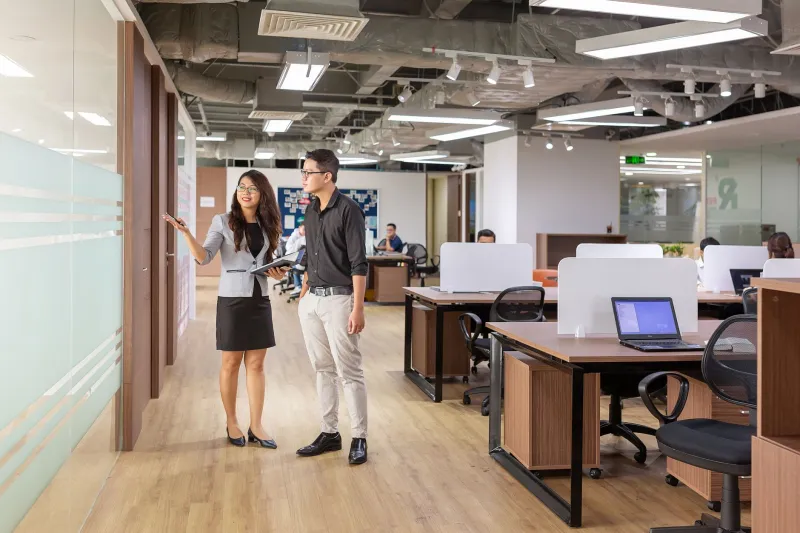
Beyond ergonomics, the visual quality of flooring communicates something important about organizational culture. In an era where talent—particularly among younger professionals—increasingly evaluates potential employers through the lens of brand identity and workplace culture, the aesthetic coherence of a facility matters. Employees and job candidates alike make rapid assessments about an organization's investment in its people based on what they see during an office tour or a first day of work.
Flooring that aligns with a coherent design vision—one that reflects the company's values, industry, and culture—contributes to a sense of pride in the workplace. This is not superficial. Research in environmental psychology consistently demonstrates that people perform better, collaborate more readily, and report higher job satisfaction in spaces they find visually appealing and thoughtfully designed. Flooring, as the literal foundation of every workspace, is a primary contributor to that visual experience.
For facility managers working within budget constraints, this does not mean selecting the most expensive product on the market. It means making intentional choices—selecting colors, textures, and materials that reinforce the organization's identity and create a cohesive, professional atmosphere. A well-executed flooring plan with mid-range commercial-grade products will consistently outperform a poorly conceived plan using premium materials.
The Recruitment Dimension
Employee retention and talent acquisition are two sides of the same coin. Organizations that struggle to retain employees often find themselves in a cycle of constant recruitment—an exhausting and costly dynamic that undermines growth and morale simultaneously. The physical workspace is increasingly a factor in recruitment decisions, particularly in competitive labor markets.
Candidates who tour a facility during the interview process form lasting impressions based on what they observe. A modern, well-maintained workspace—one where flooring is clean, current, and appropriate for the environment—communicates that the organization is stable, professionally managed, and invested in the employee experience. The inverse is equally true: dated, damaged, or inappropriate flooring can raise questions about organizational priorities before a single conversation about salary or benefits has taken place.
Calculating the Return
Facility managers and CFOs are understandably focused on cost-per-square-foot when evaluating flooring investments. But total cost of ownership analysis—one that accounts for durability, maintenance requirements, and lifecycle performance—only tells part of the story. The more complete financial picture includes the retention value embedded in a well-designed, high-quality workspace.
Consider this: if a flooring upgrade contributes to even a modest improvement in annual employee retention—say, reducing turnover by two or three percentage points in a mid-sized facility—the cost savings generated by avoided recruiting and onboarding expenses can substantially offset, or in some cases entirely cover, the cost of the installation. This is not speculative accounting. It is a straightforward application of the same ROI logic that organizations apply to technology investments, benefits programs, and training initiatives.
The challenge is that flooring's contribution to retention is diffuse and indirect, making it harder to isolate in a spreadsheet. But difficulty of measurement does not equal absence of impact. Organizations that take a holistic view of their real estate and facility investments—one that incorporates employee experience alongside operational performance—are better positioned to make flooring decisions that deliver value across multiple dimensions.
A Strategic Opportunity for Facility Managers
For facility managers and operations leaders looking to demonstrate strategic value to their organizations, flooring presents a compelling opportunity. Framing flooring investments in the language of talent strategy—rather than purely in terms of maintenance cycles and durability specifications—opens the door to broader organizational support and more meaningful budget conversations.
The argument is straightforward: the floor is not just a surface. It is part of the employee experience. It contributes to physical wellbeing, aesthetic satisfaction, and the daily sense of whether the workplace is a place worth showing up to. In a labor market where talent retention remains a top organizational priority, that contribution deserves to be taken seriously.
At Tarkett USA, we work with facility managers, architects, and business decision-makers to identify flooring solutions that meet the full spectrum of commercial performance requirements—including the human ones. Because a floor that works for your people is a floor that works for your business.