The True Price of Cheap Floors: Understanding Total Cost of Ownership Before You Buy

Walk into any big-box home improvement store in America and you will find flooring options spanning an enormous price range — from vinyl planks priced at under $1.00 per square foot to engineered hardwood or luxury commercial tile pushing well past $10.00. For many homeowners and facility managers, the instinct is understandable: minimize the upfront outlay and redirect savings elsewhere in the project budget. But that logic, however intuitive, frequently proves costly in the long run.
The concept of total cost of ownership (TCO) — a financial framework borrowed from enterprise technology procurement — applies with remarkable precision to flooring decisions. When you account for installation, routine maintenance, refinishing or replacement cycles, and the hidden costs of downtime or disruption, the economic picture shifts dramatically.
Why the Purchase Price Is Only the Beginning
Consider a mid-sized commercial office environment covering 10,000 square feet in the Midwest. A facilities director selects a budget-tier carpet tile at $2.50 per square foot, representing a $25,000 material investment. On the surface, this appears to be a responsible allocation of capital.
Over a ten-year period, however, that same carpet tile will require:
- Annual professional deep cleaning, averaging $0.25–$0.35 per square foot per year, totaling approximately $30,000 over a decade
- Spot replacement of high-traffic tiles every three to four years, adding another $8,000–$12,000
- Full replacement around year seven or eight, as budget-tier fibers lose resilience and appearance retention well before premium alternatives
By year ten, the total expenditure on that initially affordable carpet tile approaches or exceeds $80,000 — more than triple the original purchase price.
Contrast this with a commercial-grade luxury vinyl tile (LVT) product at $5.50 per square foot, representing a $55,000 upfront investment. Premium LVT engineered for commercial wear layers of 20 mil or greater carries a realistic service life of 15–20 years in moderate-traffic environments. Annual maintenance costs are substantially lower — typically $0.10–$0.15 per square foot — and refinishing or full replacement is deferred significantly. The ten-year TCO for this scenario frequently lands in the $70,000–$75,000 range, with a product that remains structurally and aesthetically viable well into the second decade.
The Maintenance Multiplier: Where Budget Products Fall Short
One of the most consistent patterns in flooring lifecycle analysis is what industry professionals sometimes call the maintenance multiplier — the ratio between a product's ongoing upkeep costs and its original purchase price. Budget flooring products almost universally carry higher maintenance multipliers than their premium counterparts.
Laminate flooring, for example, is susceptible to moisture infiltration at seams, which can cause swelling and delamination in kitchens, bathrooms, or humid climates like those found in the Gulf Coast states or Pacific Northwest. A single moisture event that goes unaddressed can render an entire section of laminate floor unsalvageable, requiring not just material replacement but subfloor remediation. Premium waterproof LVT or porcelain tile, by contrast, is engineered to withstand these conditions without structural compromise.
Similarly, solid hardwood flooring — while beautiful and long-lasting when properly maintained — demands refinishing every seven to ten years in residential environments and more frequently in commercial settings. Each refinishing cycle carries both a direct cost ($3.00–$5.00 per square foot for professional sanding and recoating) and an indirect cost: the space is unusable for several days, a significant consideration for businesses or homeowners with full schedules.
A Framework for Calculating Your Own TCO
For contractors advising clients and facility managers preparing capital plans, a straightforward TCO framework can be applied to any flooring decision:
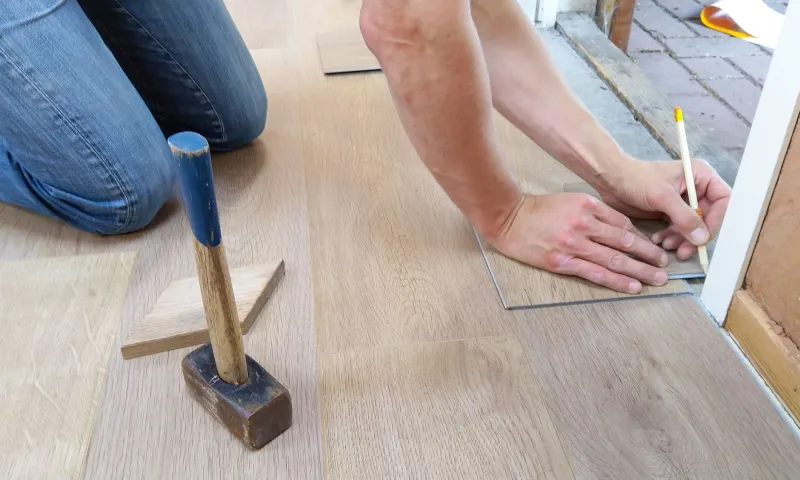
Step 1: Establish the baseline. Multiply the material cost per square foot by the total area. Add professional installation costs, which vary by product and region but typically range from $2.00 to $6.00 per square foot.
Step 2: Project annual maintenance. Research the recommended maintenance protocol for each product under consideration. Factor in professional cleaning, sealing, or recoating costs on an annualized basis.
Step 3: Estimate replacement intervals. Use manufacturer-published wear ratings and third-party durability data to project when the product will require partial or full replacement. Assign a replacement cost at that interval, including material, labor, and any associated disruption costs.
Step 4: Apply a time horizon. Run the calculation over 10 and 20 years. Many flooring decisions that appear cost-effective at five years reveal their true cost profile only when extended to longer timeframes.
Step 5: Account for environmental factors. High humidity, UV exposure, heavy foot traffic, and chemical cleaning regimens all accelerate wear on certain product categories. Adjust your projections accordingly for your specific geography and use case.
Real-World Case Study: A Pacific Northwest School District
A school district in western Oregon recently completed a renovation of three elementary school corridors, each approximately 4,500 square feet. Facing budget pressure, administrators initially proposed a standard sheet vinyl at $1.80 per square foot. A facilities consultant introduced a TCO analysis comparing that option against a commercial heterogeneous vinyl floor with a reinforced wear layer, priced at $4.20 per square foot.
Over a projected 15-year lifecycle — standard for a K–12 facility capital plan — the sheet vinyl required replacement at year eight, adding a second full installation cost to the ledger. The premium vinyl, carrying a manufacturer-backed wear warranty for the full 15-year period, required only routine buffing and periodic recoating. The TCO difference across all three corridors exceeded $47,000 in favor of the premium product, enough to fund two additional classroom renovations.
What This Means for Contractors and Facility Managers
The practical implication of TCO analysis is not that every project demands the most expensive flooring available. It is that price-per-square-foot is an incomplete metric for any decision that extends beyond the immediate installation. Flooring serves as a foundational element of any built environment — both literally and economically — and its selection deserves the same rigor applied to mechanical systems, roofing, or structural components.
Contractors who present TCO frameworks to clients distinguish themselves as strategic advisors rather than transactional vendors. Facility managers who bring lifecycle cost data to capital planning conversations are better positioned to secure appropriate budgets and avoid the reactive, higher-cost replacement cycles that plague institutions locked into perpetual budget-product purchasing.
At Tarkett, our product development philosophy is grounded in exactly this principle: that flooring engineered for durability, cleanability, and long-term performance delivers superior value to the people and organizations who rely on it — not just at the point of purchase, but across the full life of the space.