Reconfigure Without Rebuilding: How Modular Flooring Gives Offices the Agility to Keep Up With Change
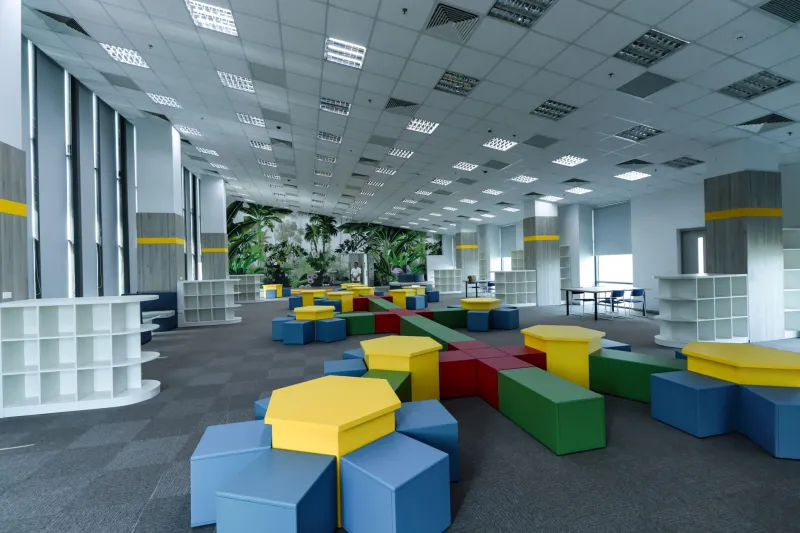
The modern American workplace is in a near-constant state of reinvention. Hybrid schedules, hot-desking programs, collaborative zones, and the ongoing push to attract employees back to the office have forced facilities managers and corporate real estate teams to rethink how their square footage is being used — sometimes on very short notice.
For many organizations, the traditional response to a shifting floor plan has been a costly and disruptive renovation. Subfloor preparation, adhesive application, extended cure times, and days or weeks of operational downtime have historically made any significant flooring change a major capital commitment. Modular flooring systems are changing that calculus entirely.
What Modular Flooring Actually Means in a Commercial Context
The term "modular flooring" encompasses a range of product formats — from click-together luxury vinyl tiles and planks to carpet tiles and loose-lay systems — that are specifically engineered for ease of installation, reconfiguration, and replacement. Unlike broadloom carpet or glued-down sheet vinyl, modular systems are designed to be installed without permanent adhesives and, crucially, removed and reinstalled without damaging the substrate beneath.
In commercial applications, this translates directly into operational flexibility. A section of flooring can be lifted, reconfigured, or replaced in hours rather than days. Individual tiles or planks that sustain wear or damage in high-traffic corridors can be swapped out without disturbing the surrounding installation. And when a company decides to rethink its entire space — say, converting a row of private offices into an open collaborative hub — the flooring can move with that vision rather than standing in its way.
The Real Cost of Inflexibility
To understand why modular systems are gaining traction across corporate campuses and commercial interiors, it helps to examine what inflexibility actually costs. A mid-sized company occupying 20,000 square feet in a Chicago or Dallas office park that decides to shift to a hybrid work model may need to eliminate dedicated workstations, introduce shared-desk neighborhoods, and carve out focus rooms or wellness areas — all within a single lease cycle.
With traditional flooring, executing that vision typically requires scheduling work crews during off-hours or weekends, sourcing matching materials that may no longer be in production, and absorbing the cost of adhesive removal and subfloor repair before any new product goes down. When you factor in lost productivity, temporary relocations, and the possibility of discovering moisture or substrate issues mid-project, the total expenditure can dwarf the original flooring budget.
Modular systems sidestep many of these friction points. Because installation typically requires no adhesives — or only minimal pressure-sensitive products — removal is clean and the substrate is largely preserved. This means reconfiguration projects can often be completed over a single weekend, with staff returning to a refreshed, fully functional workspace on Monday morning.
Zone Definition as a Strategic Tool
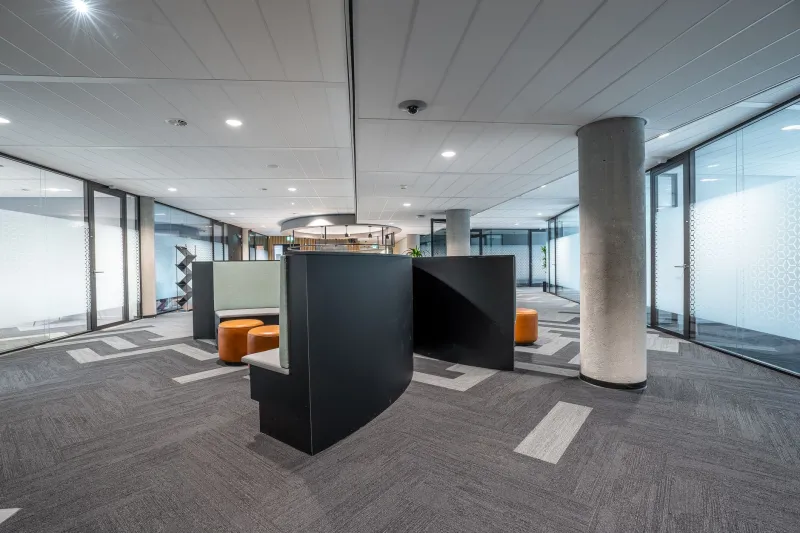
One of the more compelling applications of modular flooring in contemporary office design is its ability to define zones visually without requiring permanent architectural changes. A company piloting a new agile working model, for instance, might use contrasting carpet tile colorways to differentiate a quiet focus zone from a louder collaborative area — communicating behavioral expectations through the floor itself.
This approach has become particularly popular among technology firms, professional services companies, and healthcare organizations redesigning their administrative spaces. Rather than investing in new partition walls or furniture systems to signal spatial intent, these organizations are using flooring pattern, texture, and color transitions to guide movement and set tone. If the pilot program doesn't achieve the desired results, the flooring can be reconfigured for a fraction of the cost of structural changes.
Hot-desking programs — in which employees reserve workstations rather than occupying assigned seats — have created a similar demand for adaptable floor layouts. As desk neighborhoods are added, reduced, or repositioned based on real-time occupancy data, the flooring beneath them needs to accommodate those shifts. Modular systems make it possible to expand a neighborhood zone into adjacent space, or pull it back, without creating visible seams or mismatched patches.
Sustainability and Lifecycle Considerations
Beyond operational agility, modular flooring systems offer a meaningful sustainability advantage that resonates with corporate environmental, social, and governance (ESG) commitments. When a traditional glued-down floor reaches the end of its useful life or becomes aesthetically dated, the entire installation — substrate adhesive included — typically goes to landfill. Modular products, by contrast, can often be reclaimed, refurbished, or recycled at end of life.
Facilities teams that have adopted modular systems also report lower material waste during initial installation, since individual tiles or planks can be cut and repositioned with greater precision than rolled goods. And because damaged sections can be replaced individually rather than requiring a full-area tear-out, the effective lifespan of a modular floor installation can extend significantly beyond that of comparable traditional products.
For companies pursuing LEED certification or working toward internal sustainability benchmarks, these lifecycle advantages carry real weight in both documentation and reporting.
Planning a Modular Transition: What Facilities Teams Should Know
For organizations considering a shift to modular flooring — whether for a single floor refresh or a phased campus-wide program — a few planning considerations are worth addressing early.
Subfloor condition matters. While modular systems are forgiving in many respects, they still perform best over flat, clean, and structurally sound substrates. A pre-installation assessment can identify any areas requiring leveling or repair before product goes down.
Inventory management is a long-term asset. Maintaining a modest stock of matching tiles or planks from the original installation ensures that future spot replacements are seamless. Specifying products from manufacturers with strong pattern and color continuity programs reduces the risk of visible mismatches as the product line evolves.
Phased rollouts are entirely viable. Unlike some flooring products that require a continuous installation to look cohesive, many modular systems are specifically designed to accommodate phased installation — meaning a company can refresh one floor or one zone at a time without creating an awkward visual transition.
The Broader Shift Toward Adaptive Workplaces
The rise of modular flooring in commercial environments reflects a broader shift in how American organizations think about their physical spaces. The static, fixed office — built once and expected to serve unchanged for a decade — is giving way to a more dynamic model in which space is treated as a resource to be actively managed and optimized.
Flooring, historically one of the most permanent and disruptive elements of any interior, is now positioned as a tool for agility rather than a constraint on it. For facilities managers, interior designers, and corporate real estate professionals navigating the demands of today's workplace, that shift represents a meaningful expansion of what's possible — without the renovation budget to match.