Built Tough, Designed to Impress: When Industrial Flooring Standards Meet Customer-Facing Spaces

There was a time when the flooring in a distribution center and the flooring in a flagship retail store occupied entirely separate universes — one defined by load ratings and chemical resistance, the other by color trends and surface sheen. That boundary has been eroding steadily, and in some of the most forward-looking commercial interiors in the country, it has disappeared entirely.
The aesthetic that design professionals sometimes call "industrial chic" has moved well beyond exposed ductwork and reclaimed wood accent walls. Today, it extends beneath the feet of shoppers, hotel guests, and restaurant patrons in the form of flooring materials that were engineered for punishment and are now being deployed as deliberate design statements. Understanding why this shift is happening — and how to specify these products effectively — is increasingly valuable knowledge for contractors and design professionals operating in the commercial renovation space.
The Performance Logic Behind the Aesthetic Trend
The appeal of industrial-grade flooring in retail and hospitality environments is not purely visual. It is rooted in a straightforward performance calculation that more operators are beginning to make explicitly.
High-traffic retail environments subject flooring to conditions that would compromise many traditional commercial-grade products within a few years. Shopping carts, pallet jacks during restocking hours, stiletto heels, and the relentless foot traffic of a busy urban location all generate wear patterns that accelerate surface degradation. In hospitality settings, the combination of spilled liquids, cleaning chemicals, and the weight of furniture being rearranged for events creates similarly demanding conditions.
Industrial flooring categories — polished concrete, heavy-duty luxury vinyl tile with reinforced wear layers, epoxy and polyurethane resin systems, and large-format porcelain tile rated for industrial applications — were engineered to withstand exactly these kinds of stresses. When operators began specifying them in customer-facing spaces, they discovered that the durability advantage translated directly into reduced maintenance costs and extended replacement cycles. The aesthetic alignment with contemporary design trends turned out to be a secondary benefit that made an already sound operational decision considerably easier to justify.
Polished Concrete: From Loading Dock to Lifestyle Brand
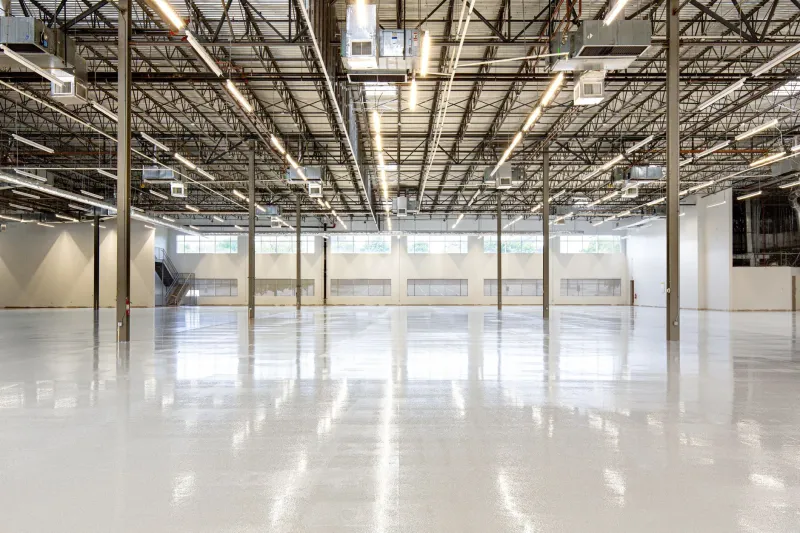
Few materials illustrate this transition more vividly than polished concrete. Once confined to manufacturing floors and parking structures, polished and stained concrete has become a signature flooring choice for a wide range of retail and food-and-beverage concepts across the United States.
The appeal is multifaceted. Polished concrete is exceptionally durable, resistant to most spills when properly sealed, and requires relatively straightforward maintenance compared with many alternative hard-surface options. Its visual range is broader than many designers initially expect — aggregate exposure levels, surface sheen, integral color, and decorative scoring can combine to produce results that range from raw industrial to refined minimalist.
For contractors, polished concrete projects in retail environments require careful attention to the existing substrate condition, moisture vapor transmission rates, and the specific sealer and densifier chemistry being used. Retail spaces that are being converted from prior uses — a former bank branch becoming a boutique, or a big-box anchor being subdivided for mixed retail — frequently present substrate challenges that require remediation before polishing can begin. Contractors who develop expertise in substrate assessment and preparation for polished concrete work will find this a growing and differentiated service offering.
Heavy-Duty LVT: The Contractor's Preferred Crossover Product
If polished concrete represents the high-profile end of the industrial-to-retail flooring spectrum, commercial-grade luxury vinyl tile occupies the practical middle ground where the majority of renovation projects are actually happening.
The distinction between residential-grade and commercial-grade LVT is significant and worth articulating clearly to clients who may be tempted to specify based on price point alone. Commercial LVT products designed for high-traffic environments feature wear layers measured in millimeters rather than mils, fiberglass or composite core constructions that resist indentation under point loads, and surface treatments that maintain appearance under sustained foot traffic. The best commercial-grade products carry wear ratings that reflect genuinely industrial performance expectations.
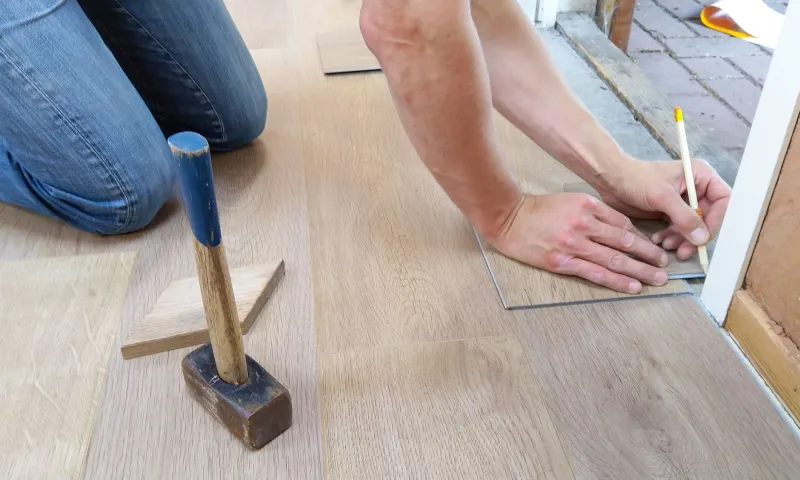
In retail renovation projects, these products offer contractors a combination of advantages that is difficult to match with alternative materials. Installation is faster than ceramic or stone tile, requires no curing time, and can often be completed with the store partially operational — a significant logistical consideration for retailers who cannot afford extended closure periods. The range of available formats, including large-format tiles that replicate the visual scale of natural stone, and plank formats that mimic wide-board hardwood, gives designers substantial creative latitude within a single product category.
Resin Floor Systems in Hospitality and Food Service
Seamless resin flooring — including epoxy, polyurethane, and methyl methacrylate (MMA) systems — has been a standard specification in commercial kitchens and food processing facilities for decades, valued for its hygienic, grout-free surface and chemical resistance. A newer generation of decorative resin systems is now finding its way into the dining rooms, lobbies, and retail floors that adjoin those back-of-house spaces.
The design possibilities within decorative resin systems are considerable. Metallic pigments, broadcast aggregates, and custom color formulations can produce surfaces that read as genuinely luxurious while delivering the cleanability and slip-resistance performance that operators need. Several hospitality groups operating in major US markets have used decorative resin flooring to create signature lobby and bar environments that are simultaneously striking and maintenance-efficient — a combination that is difficult to achieve with more conventional flooring categories.
For contractors, resin flooring installation requires specific training and equipment, and the application environment must meet temperature and humidity specifications to ensure proper cure. Substrate preparation is critical: resin systems applied over compromised or contaminated concrete will delaminate. Contractors who invest in resin flooring competency, however, are positioning themselves for a category that is growing in both the commercial renovation and new construction markets.
Specifying for the Overlap: What Contractors Need to Know
When a client asks for flooring that looks like it belongs in a design magazine but performs like it belongs in a warehouse, the specification process requires more precision than either a purely aesthetic or purely functional brief would demand.
Several questions should guide the conversation early:
What are the actual traffic and load conditions? Retail foot traffic varies enormously between a neighborhood boutique and a high-volume mass-market location. The flooring specification should reflect the realistic worst-case scenario for that specific environment, not a generic retail benchmark.
What are the maintenance capabilities of the facility team? Industrial flooring materials often require specific maintenance protocols to preserve their performance and appearance. A polished concrete floor that is mopped with the wrong chemistry will lose its sheen. An epoxy resin floor that is not resealed on schedule will begin to show wear. Specifying a product that the facility team cannot maintain correctly is a recipe for client dissatisfaction regardless of how appropriate the material might be in theory.
What does the installation timeline allow? As noted above, different industrial flooring categories have very different installation timelines and operational disruption profiles. For occupied retail spaces, this consideration can be decisive.
What warranty and performance documentation is available? Industrial flooring products specified in customer-facing environments should carry commercial warranty documentation that reflects their actual intended use. Contractors should verify that the manufacturer's warranty covers the specific application being proposed.
The convergence of industrial performance and elevated design in commercial flooring is not a passing trend. It reflects a fundamental recalibration of how operators think about the long-term economics of their built environments. Contractors and facility managers who understand both dimensions of this equation are well positioned to deliver outcomes that satisfy on every level.