End of the Line or Room to Run? A Facility Manager's Guide to Flooring Lifecycle Decisions
A scuffed surface or a dull finish does not automatically signal a failing floor. Conversely, a floor that still looks presentable may be concealing structural problems that will compound over time. For facility managers and building owners navigating renovation budgets, the ability to distinguish between these two conditions is not just useful—it is financially essential.
The choice between restoration and replacement carries consequences that extend well beyond the immediate project cost. Get it wrong in either direction, and you either spend money on a floor that needed to be pulled up anyway, or you discard a surface that had years of productive life remaining. Getting it right requires a systematic evaluation of material condition, subfloor integrity, expected use, and long-term cost trajectories.
Understanding What "Worn" Actually Means by Material Type
Not all flooring materials age the same way, and the restoration options available to you are largely determined by what is underfoot.
Hardwood and engineered wood are among the most forgiving materials from a lifecycle standpoint. Solid hardwood can typically be sanded and refinished multiple times before the wear layer becomes too thin to support the process—often three to five refinishing cycles over the floor's life. Engineered hardwood offers fewer refinishing opportunities, usually one to three, depending on the thickness of the veneer layer. The key diagnostic question is how much material remains above the tongue-and-groove joint. A flooring professional can measure this directly. If sufficient thickness exists, refinishing is almost always the more economical path.
Luxury vinyl plank and tile (LVP/LVT) present a different calculus. These surfaces cannot be sanded or refinished in the traditional sense. However, they are highly durable and resistant to moisture and abrasion, which means visible wear often develops slowly. When LVP or LVT does reach end of life—typically indicated by peeling, lifting edges, or wear-through of the protective layer—replacement is generally the only option. The relatively lower cost of quality vinyl flooring, combined with its ease of installation, often makes full replacement more cost-effective than attempting partial repairs, which can result in visible mismatches.
Carpet operates on a shorter lifecycle than hard surfaces, typically seven to fifteen years in commercial settings depending on traffic volume and maintenance practices. Matting—the permanent compression of fibers in high-traffic lanes—is the clearest sign that a carpet has reached its limit. Cleaning and re-stretching can address some issues, but matted fibers do not recover. Carpet tile, however, offers a meaningful middle ground: individual tiles in heavily trafficked zones can be replaced without disturbing the broader installation, extending the effective life of the system considerably.
Polished concrete and epoxy coatings are highly durable but can develop micro-cracks, delamination, or surface pitting over time. Light surface damage is often addressable through recoating or repolishing. Widespread delamination or substrate cracking, however, points to problems that surface treatments cannot resolve.
The Subfloor Question: The Variable That Changes Everything
One of the most common errors in flooring lifecycle assessment is evaluating the surface in isolation. The condition of the subfloor is equally important—and sometimes more so.
Soft spots, squeaking, visible deflection under foot traffic, or evidence of moisture intrusion are all signs that the subfloor may require attention regardless of what the finished surface looks like. In some cases, a cosmetically worn floor is sitting on a perfectly sound subfloor, making refinishing or re-covering a straightforward solution. In others, a floor that appears serviceable is masking subfloor deterioration that will compromise any new installation if not addressed first.
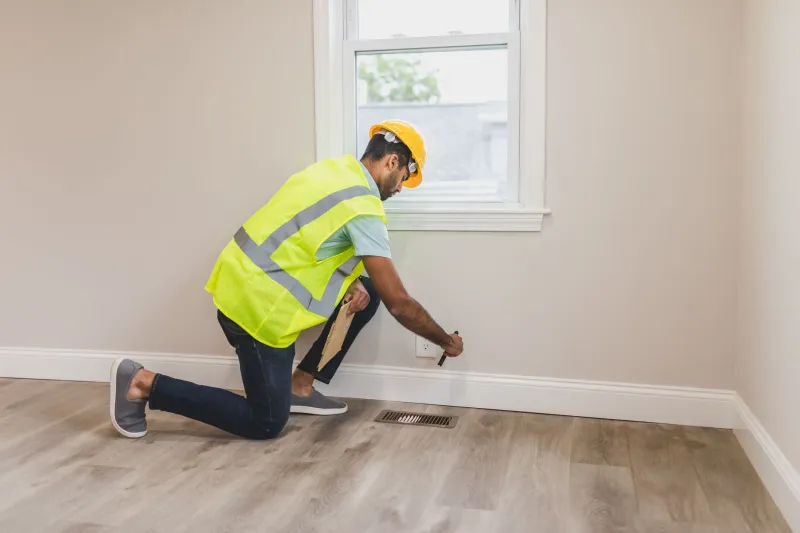
Before committing to either restoration or replacement, a qualified contractor should assess the subfloor directly. This may involve pulling up a section of flooring in a low-visibility area or using moisture meters and deflection testing to gather objective data. Skipping this step is a common and costly mistake.
Real-World Cost Comparisons Across Material Types
Cost differentials between refinishing and replacement vary significantly by material, but the gap is often larger than facility managers anticipate.
For solid hardwood, professional sanding and refinishing typically runs between $3 and $8 per square foot, depending on the region and the condition of the floor. Full replacement of comparable hardwood flooring, including materials and installation, can range from $10 to $20 per square foot or more. In a 5,000-square-foot space, that difference can represent $35,000 to $60,000—a meaningful figure in any capital planning context.
For carpet, commercial-grade replacement averages $4 to $8 per square foot installed, while professional deep cleaning and re-stretching costs a fraction of that. However, if the carpet has reached the matting threshold, cleaning expenditures deliver diminishing returns. A realistic three-year projection of maintenance costs versus replacement cost often reveals that early replacement is the more economical long-term decision.
For LVP and LVT, the relatively lower replacement cost—often $3 to $7 per square foot installed for quality commercial product—reduces the financial stakes of the decision, but still favors thoughtful evaluation over reactive replacement.
Establishing a Lifecycle Inspection Protocol
Rather than making flooring decisions reactively, high-performing facility management programs build structured inspection protocols into their annual operations calendar. A twice-yearly visual assessment, combined with a more detailed condition evaluation every three to five years, creates a documented record of surface progression that supports both maintenance planning and capital budget requests.
Key indicators to track over time include:
- Finish depth and sheen uniformity (hard surfaces)
- Fiber density and resilience (carpet)
- Edge adhesion and seam integrity (vinyl and LVT)
- Surface levelness and subfloor stability (all types)
- Moisture readings in areas prone to humidity or water exposure
When these records are maintained consistently, the decision between refinishing and replacement becomes less subjective and more defensible—both internally and to stakeholders reviewing capital expenditure proposals.
The Replacement Case: When Refinishing Is No Longer the Right Answer
There are clear circumstances in which replacement is the correct decision regardless of cost considerations. These include: floors where the wear layer has been fully depleted and cannot support refinishing; surfaces with widespread subfloor damage that must be addressed before any new installation; areas where moisture damage has compromised adhesion or structural integrity; and spaces where the existing flooring no longer meets current safety, acoustic, or accessibility standards.
In these situations, attempting to extend a floor's life through surface treatments is not prudent stewardship—it is deferred expense. The more financially sound approach is to plan the replacement strategically, phasing the work where possible to minimize operational disruption and spread capital costs across budget cycles.
The floors in your facility are telling a story. The skill lies in reading it accurately.