Underfoot and Overlooked: The Science of Floor Feel and Its Real Impact on People and Performance
When facility managers and building owners evaluate flooring options, the conversation typically gravitates toward three variables: how long will it last, what will it cost, and how will it look. These are legitimate considerations, and they deserve rigorous analysis. But they represent an incomplete picture of what flooring actually does in a commercial environment.
Beneath the surface—quite literally—flooring materials influence the physical experience of the people who occupy a space. The warmth or chill underfoot, the degree to which a surface absorbs or returns energy with each step, and the tactile feedback a floor provides all have measurable effects on human physiology and behavior. Understanding these effects is not a matter of interior design philosophy. It is a matter of performance.
The Thermal Dimension: Why Floor Temperature Is a Workplace Variable
Most HVAC systems are designed to manage air temperature. Floor temperature receives comparatively little attention in commercial building design—yet it is one of the first environmental variables that occupants notice and respond to.
Hard surface flooring materials, particularly polished concrete, ceramic tile, and some luxury vinyl products, tend to have low thermal resistance. They absorb and conduct heat efficiently, which means they can feel noticeably cold underfoot in cooler months, especially in buildings with concrete slab construction or those located in northern US climates. This thermal discomfort is not trivial. Studies in occupational health literature have linked prolonged contact with cold floor surfaces to increased physical fatigue, reduced circulation in the lower extremities, and greater reported discomfort among workers who spend significant portions of their day standing.
Carpet and cushion-backed resilient flooring offer meaningfully higher thermal resistance. In spaces where employees stand for extended periods—healthcare facilities, retail environments, light manufacturing areas, and open-plan offices without dedicated seating—the thermal insulation properties of flooring can directly affect how long workers remain comfortable and productive.
For facility managers in mixed-climate US markets, the thermal profile of flooring is particularly relevant in transitional seasons, when exterior temperatures fluctuate and HVAC systems lag behind. Flooring that maintains a more stable surface temperature reduces the burden on climate control systems and contributes to a more consistent occupant experience year-round.
Cushioning and Fatigue: What the Research Actually Shows
The relationship between floor hardness and physical fatigue is well-documented in ergonomics research. Workers who stand on hard surfaces for extended periods experience measurably greater musculoskeletal strain than those on cushioned or resilient surfaces—a finding that has been replicated across industries from retail and hospitality to healthcare and manufacturing.
The mechanism is straightforward: hard floors return energy directly to the body with each step. Resilient surfaces—those with some degree of give or cushioning—absorb a portion of that energy, reducing the cumulative load on joints, tendons, and the lower back. Over the course of an eight-hour shift, this difference is not marginal. It accumulates into meaningful variation in fatigue levels, reported discomfort, and—according to several occupational health studies—productivity and error rates.
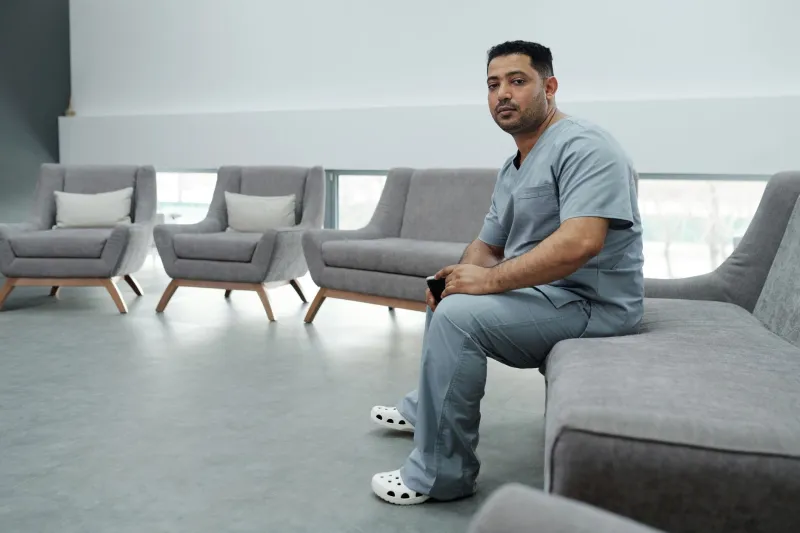
This has practical implications for flooring selection in commercial environments where standing or walking is a significant component of daily activity. In healthcare settings, where clinical staff may cover several miles of floor in a single shift, the underfoot characteristics of corridor and patient room flooring directly affect workforce wellbeing and retention. In retail environments, where floor associates stand throughout their shifts, resilient flooring can reduce the physical cost of the job in ways that translate to better customer service and lower turnover.
The flooring industry has responded to this evidence with products specifically engineered for comfort performance. Cushion-backed luxury vinyl, acoustic-rated carpet systems, and specialty resilient flooring with integrated foam or cork layers offer measurably different fatigue profiles than standard hard surface products. Specifying these materials in appropriate applications is a decision that pays dividends in human terms—and, by extension, in operational ones.
Tactile Feedback and Spatial Navigation
Beyond temperature and cushioning, flooring communicates information to occupants through tactile feedback—the sensory signals generated by variations in texture, firmness, and surface character. This dimension of floor feel is perhaps the least discussed, but it plays a meaningful role in how people navigate and experience commercial spaces.
In healthcare environments, tactile differentiation between flooring zones helps orient patients and visitors who may be disoriented or visually impaired. A transition from smooth vinyl to textured carpet signals a change in environment in a way that is perceptible even without conscious attention. This is particularly relevant in memory care and rehabilitation settings, where spatial cuing through flooring can support wayfinding and reduce anxiety.
In retail and hospitality environments, surface texture influences pace and dwell time in ways that affect commercial outcomes. Research in environmental psychology has found that harder, smoother surfaces tend to accelerate foot traffic—people move more quickly across them. Softer, more textured surfaces slow movement and encourage lingering, which in retail contexts correlates with higher per-visit spend. This is not coincidental; it is a design principle that sophisticated retail operators apply deliberately.
For corporate interiors, tactile variation between zones reinforces the activity-based design logic discussed in broader workplace literature. A transition from hard surface to carpet at the threshold of a focus area is not just a visual signal—it is a physical one, and it is processed by the nervous system in ways that support behavioral transition.
Quantifying Comfort: Moving from Intuition to Specification
One of the challenges in making the case for comfort-oriented flooring is that its benefits are diffuse and difficult to attribute directly to a single capital decision. A reduction in worker fatigue, an increase in retail dwell time, or an improvement in tenant satisfaction scores may reflect flooring choices—but they also reflect lighting, temperature, layout, and dozens of other variables.
Despite this complexity, facility managers and building owners have several tools available for making more evidence-based flooring decisions.
Material data sheets and third-party certifications increasingly include comfort-relevant specifications: thermal resistance values (R-values), impact sound ratings, and cushioning measurements that allow direct comparison between products. Requesting this data as part of the specification process moves the conversation from subjective preference to objective performance.
Occupant satisfaction surveys administered before and after flooring upgrades can capture comfort-related feedback in a structured way, providing data that supports future capital planning arguments.
Pilot installations in representative zones—a single floor of a multi-story building, or one department within a larger facility—allow real-world performance data to be gathered before a full-scale commitment.
Rethinking What a Floor Is For
The most durable and cost-effective floor in a building is not necessarily the one that serves its occupants best. A surface that outlasts its expected lifecycle while quietly contributing to workforce fatigue, spatial disorientation, or thermal discomfort may be delivering a poor return on investment in ways that never appear on a maintenance ledger.
Building the full performance profile of a flooring system—including its thermal, ergonomic, and tactile characteristics—into the specification process is not a luxury consideration. It is a more complete form of due diligence. The people who walk your floors every day are telling you something. The question is whether you are listening.