First Impressions, Lasting Impact: How Entryway Flooring Shapes the Way Customers Experience Your Brand
There is a moment that happens in every customer-facing commercial space—a moment that occurs before any transaction, before any conversation, and often before a customer has consciously registered that they have formed an opinion. It happens in the first three to five seconds of entering a space, and it is shaped almost entirely by sensory information: light, scale, smell, and the surface underfoot.
Facility designers and brand strategists have long understood the power of that moment. But flooring—one of the most dominant visual and tactile elements in any entry space—is frequently treated as a backdrop rather than a strategic asset. That represents a significant missed opportunity. The material, color, pattern, and condition of entryway flooring communicates something about every organization that installs it. The question is whether that communication is intentional.
The Psychology of the Threshold
Environmental psychology research consistently demonstrates that humans form rapid, largely subconscious assessments of spaces based on physical cues. In commercial environments, those assessments translate directly into attitudes about the organizations that occupy those spaces. A lobby that reads as clean, ordered, and well-maintained signals organizational competence. A retail storefront with fresh, design-forward flooring signals brand confidence. A service entry that is worn, stained, or visually inconsistent signals neglect—regardless of the quality of the service being offered inside.
Flooring is particularly powerful in this context because it is unavoidable. Unlike artwork, signage, or furniture, a floor cannot be ignored. Customers walk across it, look down at it, and—on a level that rarely reaches conscious thought—evaluate it. When the floor is right, it reinforces every other positive signal in the space. When it is wrong, it undermines them.
Color psychology adds another layer of complexity to this dynamic. Warm tones in entryway flooring—amber-toned woods, terracotta-adjacent luxury vinyl, warm-hued carpet—create a sense of welcome and approachability that is particularly effective in hospitality, healthcare, and retail environments where emotional comfort is a business objective. Cooler palettes—slate-toned porcelain looks, gray-scale LVT, neutral commercial carpet—project precision and professionalism, making them well-suited to financial services, legal, and technology-sector lobbies where competence signaling is the priority.
Retail: Where the Floor Drives the Journey
In retail environments, the entryway floor is the opening statement of the customer journey, and it should be designed with the same intentionality as the rest of the brand experience. Consider how major American retailers approach this: the transition from exterior sidewalk to interior retail floor is rarely accidental. That transition is engineered to create a psychological shift—from public space to brand space—and flooring is the primary tool for achieving it.
Luxury retailers frequently use dramatic material contrasts at the threshold: polished stone or high-gloss LVT inside against concrete or pavers outside. The contrast itself communicates elevation and exclusivity. Specialty retailers may use bold pattern or brand-specific color in the entry zone, creating an immediate visual anchor that orients customers and reinforces brand identity. Mass-market retailers often prioritize durability and cleanliness signals in their entry flooring, recognizing that a well-maintained high-traffic floor communicates operational competence to value-conscious shoppers.
Tarkett's commercial resilient flooring lines offer the breadth of design options—from woodgrain and stone visual patterns to bold geometric and abstract designs—that allow retail designers to achieve these effects without sacrificing the durability required in genuine high-traffic entry conditions. The ability to select a design-forward aesthetic that also meets the performance demands of a busy storefront threshold is not a compromise; it is the baseline expectation of modern commercial flooring.
Corporate Lobbies: The Brand Before the Meeting
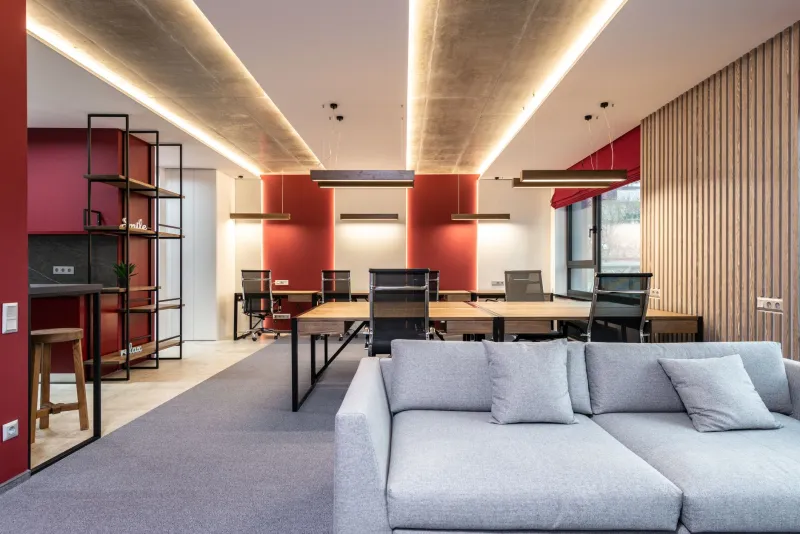
For professional service firms, corporate headquarters, and institutional organizations, the lobby is the first physical manifestation of the brand that clients and visitors encounter. In a landscape where so much business relationship-building has migrated to digital channels, the physical lobby has actually gained importance as a differentiator—it is one of the few remaining touchpoints where an organization can make a fully embodied, three-dimensional impression.
Flooring in corporate lobby environments must balance several competing demands. It must be visually distinctive enough to reinforce brand identity without being so assertive that it overwhelms the space. It must withstand the wear of daily traffic—including rolling luggage, umbrellas, and the tracked-in debris of American weather—while maintaining the appearance standards that the brand requires. And it must coordinate with the broader design language of the space: furniture, lighting, wall finishes, and architectural elements.
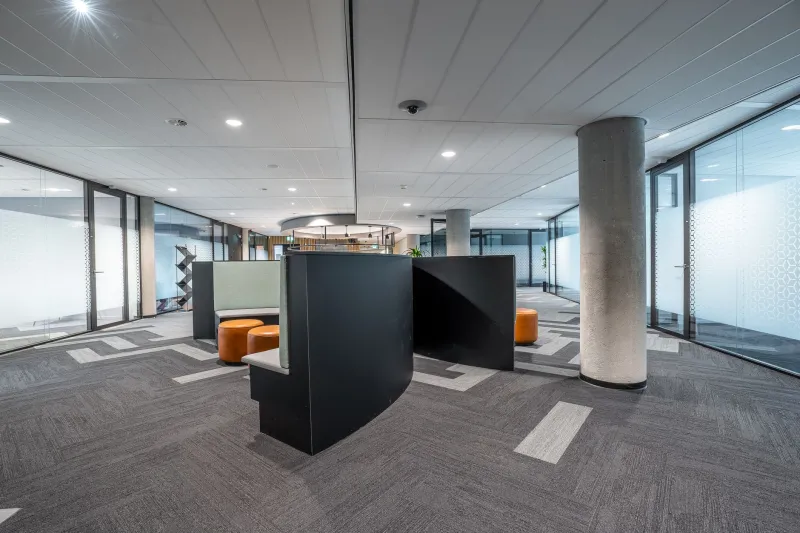
Modular flooring formats—carpet tile and luxury vinyl plank or tile—offer particular advantages in lobby environments because they enable zone-specific design decisions. A corporate lobby might feature a bold patterned carpet tile installation in the central seating area, transitioning to a cleaner, more neutral LVT in the reception zone, with a distinct transition material marking the threshold between public and private areas of the floor plate. This kind of zoning creates visual interest and spatial hierarchy while giving facility managers the flexibility to replace high-wear sections without disrupting the entire installation.
Service Entries: The Brand Behind the Scenes
It is worth addressing a category of entry space that is often overlooked in brand-focused design discussions: the service entry. For hospitality properties, healthcare facilities, and large commercial buildings, service entries—loading docks, staff entrances, back-of-house corridors—are the spaces where employees and vendors form their first impressions of the organization.
The condition and quality of these spaces communicates organizational values as clearly to employees as a polished lobby communicates them to clients. A service entry that is well-lit, cleanly finished, and maintained to a consistent standard signals that the organization values the people who work there—not just the people who visit. This matters for recruitment, retention, and organizational culture in ways that are increasingly well-documented in workplace research.
Functional flooring in service entry environments must prioritize slip resistance, moisture management, and ease of cleaning above all else. Tarkett's commercial sheet vinyl and entrance flooring systems are engineered for exactly these conditions—providing the performance characteristics that back-of-house environments demand while maintaining the quality signal that the organization's brand requires.
Designing for Durability Without Sacrificing Design
One of the persistent misconceptions in commercial flooring selection is that high-traffic durability comes at the expense of design quality. This is no longer true. Modern commercial flooring technology—particularly in the luxury vinyl and commercial carpet categories—delivers wear layer protection, dimensional stability, and cleanability standards that meet the demands of the most challenging entry environments while offering design flexibility that was simply unavailable in earlier generations of commercial flooring.
The practical implication for brand-focused facility decision-makers is this: there is no longer a legitimate reason to accept a floor that looks like a compromise. Entry flooring that is both genuinely durable and genuinely design-forward is available, and it is the right choice for any organization that takes seriously the impression its physical spaces make on the people who enter them.